Showing posts with label AFI. Show all posts
Monday, July 25, 2011
#77: All the President's Men (1976)
As somebody who lives and works in the communications world, I couldn't wait to see this film. Not just to see how different the journalistic world was over 30 years ago compared to now, but to see how two reporters essentially brought down a political power. The synopsis on my Netflix sleeve deemed this movie as, "The film that made everybody want to become a journalist," and I truly can see why. This movie not only reinforces the adage that the pen is mightier than the sword, but it says that to truly be mighty, that pen needs to be unbiased and filled with integrity.
All the President's Men is a historical print of the Watergate scandal that eventually led to Richard Nixon leaving the American presidential office. The two men who get this credit is the 1972 Washington Post reporters Bob Woodward (Robert Redford) and Carl Bernstein (Dustin Hoffman). Woodward is the rookie reporter who still goes by the book wherein Bernstein doesn't mind selling the philosophy that "it's better to ask for forgiveness than for permission." The movie follows the grueling process of getting to the bottom of the truth when the entity that's holding all the answers happens to be a little organization known as the U.S. government. Turns out, getting those answers aren't easy, and it's fascinating to get an inside look of how real journalism exposed the truth.
What I loved about this film is that there is not a single moment or scene that is wasted. This tight screenplay by master scribe, William Goldman, lets every scene have a purpose. The screenplay is much smarter than you are. And what I mean by that is that it trusts its audience to fill in the holes instead of being spoon-fed the answers. Just like Woodward and Bernstein, you start trying to solve the scandal with them, even though you know what the outcome will be. It's not about the question, “Why”, but the question, “How?”
In an age where almost everybody has a Facebook profile, it's fascinating to see a time in life where reporters had to actually do research by… gasp…. going to the library or making phone calls! You get to see how hard these two reporters had to work and it's invigorating to see the passion that they and their editors had to invest into their Watergate news stories. Despite showing a world that probably will be extinct in the near future, this movie feels strongly current. These days, newspapers are dying and the media seems to start getting the same credibility as used car salesmen, but I can't help but think that if this film was required viewing for all journalism classes, maybe there would be some hope for journalism going forward.
It was refreshing to watch a film that had my attention for its entire run time. The editing, acting and direction are all solid, but it's the story that reels you in. We live in a cynical world, but I'm so glad this film reinforces that the media and communications do indeed have the power to fight this. It gives you hope that although there is corruption in this world, there are those who are fighting to expose it. And they don't need a sword to do so.
I give All the President's Men, 5 out of 5 Deep Throats.
Wednesday, July 20, 2011
#78: Modern Times (1936)
I'm really relieved to get this movie under my belt. As a movie fan, I can now say that I've seen a Charlie Chaplin film. Chaplin and his character, the Tramp, has to be one of the most well known icons in film history, yet, I bet a big percentage of America's population has never seen any of his work. I now have the privilege to be on the other side of this bracket.
If you were wondering if he is worth all the hype, he indeed is. His comic timing and movements in Modern Times are so natural and fluid. I would find myself time after time pulling myself away from the comic antics on screen to reflect on Chaplin's unique genius.
Modern Times is a perfect title for this film because it describes the movie perfectly but also imitates life because it is known as one of the last silent films that was made in the new modern era of the "talkie" film. The film follows the Tramp in and out of scenarios where he struggles to make a living. He can never seem to keep up with the labor force of factory work or the demands of a waiter job, but with the help of a new found romance with A Gamin (Paulette Goddard), the two are still able to find hope in a society that seems to be leaving them behind.
I think this movie has made more of an impression on me as I write about it at this moment than when I was watching it. The comedic set pieces make you forget about the thematic elements that Chaplin weaves throughout the movie. He uses sound effects only for machinery and there is some spoken dialogue, but only when it is from the police radio or through the intercom system used by his factory boss. But I don't want to underplay the comedy. Chaplin is constantly throwing gags at you that are memorable and hilarious
The only downfall of the movie is that sometimes the scenes seem to exist just for Chaplin to develop humor instead of developing a plot. Scenes come off more like SNL skits at times, but what do I know? Maybe the 1934 audience was infuriated with the brutal economy, so all they were looking for was laughs. Chaplin could clearly see that there was a movement that was leaving him behind, and although the ending of this movie is somewhat bleak, he instills a hope within his characters that can't help but spill into the viewer. Life is bleak more often than not, but as the last title card states, "Buck up - never say die. We'll get along!"
I give Modern Times 4 out of 5 smuggled "nose powder."
Wednesday, February 9, 2011
#79: The Wild Bunch (1969)

The western genre is a tough one for me to tackle. Like trying sushi, I'm hesitant to indulge in the medium, but I always seem to enjoy the outcome once I try it. I think Westerns either fit into the camp of highly entertaining and action-oriented (Tombstone) or methodical and somber (Unforgiven). I would place The Wild Bunch by Sam Peckinpah in the entertaining camp, but when examined closely, exudes a lot of thought-provoking ideas that the methodical Western often brings.
The audience is thrown into choosing the difficult task of liking or despising a gang of old, yet seasoned gang of cowboys led by Pike (William Holden) and Dutch (Ernest Borgnine). After a failed, epically violent, and supposed final bank robbery, the group reluctantly decides to get out of the game for good by helping a ruthless Mexican militia. As the gang tries to dodge hired bounty hunters while stealing American weaponry for an unpredictable Mexican general, Pike and Dutch must face their inner demons and determine whether or not they are any better than the despicable people they both help and avoid.
I won't lie, it takes a while to get into this movie. Now, I watched the director's cut on Blu-ray, so I was automatically invested into a two hour and thirty minute movie. I don't know how else you can view this movie, but I imagine that the shorter version gets rid of a lot of set-up in the first hour that just isn't needed. Once you get into the journey of these crippling outlaws, the movie really becomes an entertaining ride with some very dark undertones.
When I saw that the movie was made in 1969, it made complete sense because you can easily compare this movie's themes to those of the number #84 film Easy Rider. Like Wyatt and Billy of Dennis Hopper's trippy road trip, Pike and Dutch serve as rebels with no place to call home. They resort to brutal violence to get what they think will make them feel good, but there really isn't any amount of money that can blur out their troubled souls.
This is my first Peckinpah film, but I already knew that he was always criticized for glorifying violence. I was really shocked for what was shown in this film, especially for its day. The body count could rival any Schwarzenegger movie. Although the blood doesn't make you turn your head away from the screen, there is shock when you see innocent women get murdered. Often these type of acts are seen off screen, but unlike cheesy 80’s action films, I really think Peckinpah is trying to make you aware of how disgusting, revolting, and careless violence can be. During the time this movie was being made, America was going to war in Vietnam, and you can't deny that the undertones of senseless murders that happen in this movie correlate to the current events of America going into the 70's.
Technically, I think this film was really ahead of its time, especially in its editing style. Peckinpah was using new types of cuts, especially during the action scenes, that I hadn't seen in older movies like this one. His directing style is very calculated, and you can tell that the man behind the camera is intentional in every close-up and every cinematic wide shot. The acting is also really solid and there are actually some comedic moments at times, but every once in a while the film started to feel campy, especially in some flashback scenes that I think were just not needed.
Those few cheesy moments and a lengthy set-up prevent me from giving this film a higher rating, but I really was challenged by its themes of violence, new technology, inner turmoil, and knowing when to let go. All of that and it really has some good suspenseful, fun moments. If you are a fan of Westerns, this is a must see. Those who are weary of the Western genre could go either way with this one, but I believe if you give it a chance, you won't leave dissatisfied.
I give The Wild Bunch 4 out of 5 machine guns.
Monday, October 4, 2010
#80: The Apartment (1960)

Oscar Winner:
It's really easy to overlook how great a movie The Apartment is. It's not flashy, nor in your face. It's this subtleness that makes it such a great film. Whitney and I's favorite type of movies to watch are dramadies. Those movies that could either be a drama or a comedy. At their core, the dramatic stakes are high, but there is a slice of life that makes the conflicts bearable… even entertaining. The Apartment's genius lies in its ability to focus on the characters and forget all the surrounding elements around it.
Set in a New York work environment that is now familiar because of the popularity of Mad Men on television, C.C. Baxter (Jack Lemmon) is a goofy, yet charming man, who is willing to do whatever he can to get to the top of his insurance company. That doesn't mean backstabbing his co-workers or being cutthroat, but lending his apartment to the top dogs in the company to use for their extramarital affairs. This in itself becomes a full time job as he constantly juggles the vacancy of his apartment with little promises fulfilled by his bosses. Baxter finally gets his big break when the president of the company (Fred MacMurray) wants in on Baxter's hobby. As this event causes things to finally go right in Baxter's life, as well as a budding romance with the elevator girl (Shirley MacLaine), it also causes a mess of a love triangle that is not even close to being worth the price of success.
The Apartment is about 50 years old now, but its relevancy is still so strong. The film proves that the themes of pride and the emptiness of the desire for personal and material wealth never go away. If one was able to suspend thoughts of current affairs, this film could be released for the first time today and still have just as a big of an impact as it did in 1960. This film speaks frankly about sex, affairs, and suicide, which I'm sure was a shocker for filmgoers in the 60’s, but it's amazing how things really aren't that different now than 50 years ago. People still fall in that trap that money and success can bring happiness, and I can't think of any other film that instills this idea better than this one. The world that is presented here is full of faulted people with false ideals, and that is not unlike any other day in the American life.
It's fun to see a film on this list that isn't so flashy or has some kind of gimmick to prove its brilliance. It's just great storytelling, pure and simple. The director, Billy Wilder, is one of the most admired directors to come out of Hollywood. Based on this film alone, I think there are three reasons for this. One, he knows how to cast. The acting in this film is brilliant, no matter how small or big the role is. Jack Lemmon is personally one of my favorite actors to watch and he is perfect playing a character who is extremely lovable, but so very disillusioned. Two, he lets the story be the main star of the movie, not all the other elements of film. Don't get me wrong, cinematography and set design is crucial to a film's success, but if I'm not engaged in the story, I'm done with the film. And last, Wilder is brilliant at piecing together a film. No scene is wasted. Everything that is shown or said is there for a reason and enhances the film experience. I never was distracted, nor bored. How could a film not be labeled as great?
Like a good wine, The Apartment will just get better over time. During this present economic crisis, I can't think of a better example than this film to explain why people get greedy and do the things that they do. Most importantly, this film is both fun and has substance, and I would recommend it to just about anybody.
I give The Apartment 5 out of 5 card games.
* Oh yeah, and it has probably one of the best closing lines to a movie ever.
Set in a New York work environment that is now familiar because of the popularity of Mad Men on television, C.C. Baxter (Jack Lemmon) is a goofy, yet charming man, who is willing to do whatever he can to get to the top of his insurance company. That doesn't mean backstabbing his co-workers or being cutthroat, but lending his apartment to the top dogs in the company to use for their extramarital affairs. This in itself becomes a full time job as he constantly juggles the vacancy of his apartment with little promises fulfilled by his bosses. Baxter finally gets his big break when the president of the company (Fred MacMurray) wants in on Baxter's hobby. As this event causes things to finally go right in Baxter's life, as well as a budding romance with the elevator girl (Shirley MacLaine), it also causes a mess of a love triangle that is not even close to being worth the price of success.
The Apartment is about 50 years old now, but its relevancy is still so strong. The film proves that the themes of pride and the emptiness of the desire for personal and material wealth never go away. If one was able to suspend thoughts of current affairs, this film could be released for the first time today and still have just as a big of an impact as it did in 1960. This film speaks frankly about sex, affairs, and suicide, which I'm sure was a shocker for filmgoers in the 60’s, but it's amazing how things really aren't that different now than 50 years ago. People still fall in that trap that money and success can bring happiness, and I can't think of any other film that instills this idea better than this one. The world that is presented here is full of faulted people with false ideals, and that is not unlike any other day in the American life.
It's fun to see a film on this list that isn't so flashy or has some kind of gimmick to prove its brilliance. It's just great storytelling, pure and simple. The director, Billy Wilder, is one of the most admired directors to come out of Hollywood. Based on this film alone, I think there are three reasons for this. One, he knows how to cast. The acting in this film is brilliant, no matter how small or big the role is. Jack Lemmon is personally one of my favorite actors to watch and he is perfect playing a character who is extremely lovable, but so very disillusioned. Two, he lets the story be the main star of the movie, not all the other elements of film. Don't get me wrong, cinematography and set design is crucial to a film's success, but if I'm not engaged in the story, I'm done with the film. And last, Wilder is brilliant at piecing together a film. No scene is wasted. Everything that is shown or said is there for a reason and enhances the film experience. I never was distracted, nor bored. How could a film not be labeled as great?
Like a good wine, The Apartment will just get better over time. During this present economic crisis, I can't think of a better example than this film to explain why people get greedy and do the things that they do. Most importantly, this film is both fun and has substance, and I would recommend it to just about anybody.
I give The Apartment 5 out of 5 card games.
* Oh yeah, and it has probably one of the best closing lines to a movie ever.
Sunday, September 19, 2010
#81: Spartacus (1960)

Oscar Winner:
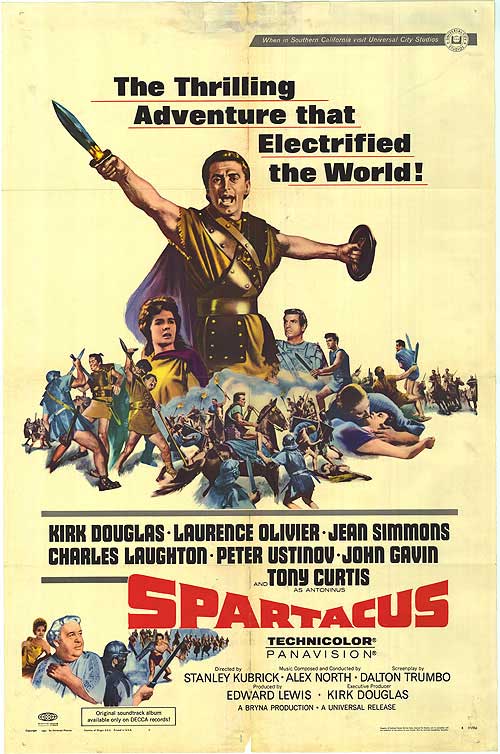
Best Cinematography, Best Supporting Actor (Peter Ustinov), Best Art Direction, Best Costume DesignI hate the word epic, especially when it's tagged as the genre of a film. It makes me think that the film is going to be long in length, have a lot of scenic shots to just show you how grand the movie actually is, and be very predictable. Spartacus easily met all these qualifications. So, the question was if I would enjoy this movie? It did take me several sittings to get through the 3 hour and 15 minute run time, but in the end, the qualities that make an epic indeed an epic, made this film an entertaining watch.
Kirk Douglas plays the title character, a tough slave who is sold into the hands of a Gladiator trainer, Batiatus (brilliantly acted by Peter Ustinov). With the brute combination of mistreatment and falling in love with one of Batiatus' slave girls (Jean Simmons), Spartacus leads a rebellion that overthrows the camp. As Spartacus leads the slaves towards their homeland, he unknowingly becomes a chess piece in a political game between two Roman senators, the republican Gracchus (Charles Laughton) and the militarist Crassus (Laurence Oliver).
Does the plot sound familiar at all? Switch out a few settings and names, and this could've totally been Gladiator or Braveheart (Oddly enough, epic, yet one of my favorite films). As mentioned before, this film is tough to get through solely on its length. If it would've been trimmed down by 45 minutes, it would have been much more watchable and I honestly think it could've retained its impact. It's interesting to know that Stanley Kubrick directed this film because it feels very dated. It's historically known that this was the last film in which he didn't have full control over all elements of the film and it shows. As a viewer, you slowly see two styles start to clash. Spartacus has that traditional Hollywood stiffness to its acting and dialogue that was so prominent in an earlier film on this list, Ben-Hur. But you begin to see Kubrick interject his now famous artistic vision in the way he stages and composes some shots. There is a much more realistic nature to the violence that must have not been seen up to that point. Spartacus is very revolutionary in the way that you can see a new style of filmmaking starting to take over the movie system.
Even though Kirk Douglas comes off like Charlton Heston at times, he definitely can carry a film, but its the supporting roles that keep one invested into the plot. I was surprised by how much more interested I became in the political maneuvering than I did the battle scenes. Unfortunately, there aren't too many surprises to what happens. I don't know if it's because that so many things that occur in the movie are now cliches in the epic genre, but when you aren't kept on the edge of your seat with a film like this, it's hard to pay attention.
That said, the plot is challenging enough to keep you invested and it really does have some moments that are truly memorable. I can now say, "I am Spartacus!" and know the emotional impact it carries. I can see why this film eked its way onto this list, but unless you just eat the epic genre up, you may could find a better feast.
I give Spartacus 3.5 out of 5 fights to the death.
* If you ever have a chance, reading about all the chaos that happened to get this film made is probably more interesting than the film itself.
Labels:
AFI,
best cinematography,
best supporting actor,
Braveheart,
Charles Laughton,
epic,
Gladiator,
Jean Simmons,
Kirk Douglas,
Kubrick,
Laurence Oliver,
Peter Ustinov,
Spartacus,
Stanley Kubrick
Sunday, August 22, 2010
#82: Sunrise: A Song of Two Humans (1927)

Oscar Winner:
*Best Picture - Unique and Artistic Production, Best Cinematography, Best Actress (Jay Gaynor)* The only time this category was awarded to a film
Ah yes... The first silent film on this list. Guess what? It's not even a comedy! It would almost take bribery to get most people to sit down and watch a silent film, but just like any type of history, one needs to discover something's past to truly gain an appreciation for it. It's been since college that I've really taken the time to sit down and watch a silent film, and although I don't recommend doing it at 10 p.m. (silent film = sleepiness), I'm so glad I did it with Sunrise.
Directed by the famous German director, F.W. Murnau (most famous for the vampire flick Nosferatu), Sunrise mixes Hitchcockian thrills and romance to tell a tale of rekindled love. Blended with the German expressionism style that Murnau made so famous (how about that film history knowledge being dropped on you!) and enhanced passion that audiences so love, Sunrise follows The Man (George O'Brien) and The Wife (Janet Gaynor) whose marriage is on the rocks. One night, The Man is tempted by The Woman From the City (Margaret Livingston) to kill his wife and leave his farm and children behind for a glorious big-city life with her. With obvious guilt-ridden feelings, The Man can't go through with the plan, but through this more-than-major set back, a stronger bond forms between the married couple.
This film is 83 years old and its amazing to see the apparent influence it has had on now current films. Two major components stood out to me. First off, I loved the cutting-edge editing and camera work of the film. Silent films always seem to be constrained in one setting, so it was refreshing to see an older movie get away from the genre’s static nature. Also, Murnau uses overlay effects to great dramatic effect that still seem innovative today. Even the very few title cards have an artistic breath to them. I couldn't help but think that Moulin Rouge was heavily influenced by this film by not just the editing, but the setting as well. Which brings me to the second component... The cinematography is beautiful. It's not a surprise that it won the Oscar for this category in the way that it captures its vast cityscapes that often had me admiring how they filmed their scenes.
Unfortunately, these technical achievements couldn't hold my attention very well when the second act of the film started. I absolutely loved the beginning and the end of this ironic fairy tale, but as the couples romance starts to bud once again, things start to slow down and it starts to feel like... well, a silent movie. Don't get me wrong, it's still a very engaging story, but the middle almost feels like a completely different film. But it's needed to have the very strong payoff at the end.
I would be remorse if I didn't mention the strong performances in the film. Silent film acting is a whole different type of performance and O'Brien and Gaynor bring so much conviction and realness to their roles. I would love to see how present actors would fair in a silent film like this. In a way, I think it would be an experiment that would really separate the really great actors from just the good ones.
If I hadn't started to get bored somewhat during the middle of this film, Sunrise would get a much higher rating for me. Despite that, I would definitely recommend it to just about anybody and if you forced to only watch one silent film to be an example for the genre, I wouldn't mind this one being it.
I give Sunrise: A Song of Two Humans 4 out of 5 drunken piglets.
Wednesday, August 18, 2010
#83: Titanic (1997)

Oscar Winner:
One of the great things about seeing films multiple times is that it can evoke an entirely different sentiment the second time around. People will always have films that they will revisit time after time, but I'm talking about a response that is the complete opposite of what you originally felt. How many times have you revisited a film from your youth and it wasn't quite as good as you remember? I had the exact opposite reaction to Titanic on second viewing. Like everybody else in 1997, I saw Titanic, but as a teenager, the romantic air of the film made me want to gag. Although I thought it was a good film, I didn't quite understand why it broke so many Oscar records. I wasn't necessarily looking forward to seeing it again, but much to my surprise, I couldn't believe how much I was swept into…. yes, I'm going to say it… a movie masterpiece.
Yes, even a young child probably knows that the Titanic was the ship that was said to be unsinkable, but the director James Cameron uses a forbidden romance between two social classes to guide us through the disaster. Torn between being her own person and high expectations of a fortune-bound marriage, spoiled Rose (Kate Winslet) reluctantly comes across an artsy, yet poor star-crossed lover in Jack (Leonardo DiCaprio). Jack slowly, but surely, starts to crumble the walls of society that Rose is so bound in, but just as the two decide to take the giant leap into forbidden devotion, an iceberg comes along and ruins their party.
Even though every movie pretty much has a three-act structure, people don't mind dividing this movie into two-halves; the romantic story and the disaster story. Although I think that the sinking of the ship is a far better part and as close to perfect filmmaking that there is, I was surprised by how much I got caught up in Jack and Rose's story. This film had to have a strong foundation for you to invest in a journey where you already know the outcome. Cameron does a brilliant job of flipping the tables and makes the unknown into what happens to this young couple. Although this romance can't help but reek of cheesiness (and is the reason for not quite making it a five-star movie), I emotionally bought into these characters as my teenager soul mocked me in the back of my mind. I'm sure Winslet and DiCaprio have to shudder a bit when they watch this film because their performances aren't necessarily the best ever, but you can for sure see the talent budding that has now made them the top tier of the acting world.
Now that I got that sappy stuff out of the way, I have to expound on how gripping the visuals of the Titanic going down were. Cameron uses special effects mixed with live action to perfection. You can definitely see the budget of this film on screen, but I was shocked at how well everything holds up here. It's been a long time since my eyes were literally glued to the screen and I was totally swept up by the impact of the impending doom. The editing of the disaster scenes are near perfect and I think what really draws you in is the secondary characters that bring a realness to the screen that is very much needed.
Titanic is a film that contains humor, romance, action, big-screen effects, drama, sadness, and most importantly, entertainment. I'm not quite sure why all those elements weren't so clear to me when I was sixteen, but thank goodness for this list to help me see the way.
I give Titanic, 4.5 out of 5 scandalous portraits.
Friday, July 2, 2010
#85: A Night at the Opera (1935)

Whenever you think of classic comedic acts, the Marx brothers are on the top of the list with the likes of Charlie Chaplin and Buster Keaton. I would dare to say, the first big act of the "talkie" era. It had been a while since I had seen this film, but their use of one-liners and physical comedy had always stayed fresh in my mind. Their sense of comedic chaos was always something I admired, so that's why I was very surprised that I couldn't fully enjoy this film as much as I wanted to. A Night at the Opera attempts to reign in their comedy with plot and story-line, and this is one of the few times that I think this is a bad thing.
Groucho, Chico and Harpo play… well, it's a little confusing what roles they actually play, but through their antics they try to bring two lovers together who are talented opera stars. The boyfriend is trying to catch a break, so the Marx brothers ban together to get rid of the evil, leading tenor so he can become famous. Set mainly in the opera house and a cruise ship, the brothers constantly become intruders and stowaways in the name of love.
Don't get me wrong, the movie is funny and that is a key ingredient. The problem lies in the fact that there are story elements that sometimes completely disregard the existence of the Marx brothers. There are musical numbers with the opera singers that are just plain boring, and even when the Marx brothers are featured in a musical number, it comes across more appropriate for one of their vaudeville shows than for the screen. I was often left just waiting for the comedy to kick back in, and trust me, when it does, it's pretty memorable. It's not really until the last scene where the director lets the Marx brothers do what they do best… create comedic anarchy.
At its core, this is still a very entertaining movie. If you've never seen a Marx brothers film, you'll be pining to see more after this one. It's just that I can't wait to watch Duck Soup (their other film on this list) that is more perfectly bound in what the brothers do best. So, maybe this is a better movie to see first so that you are void of disappointment when you see some of their other films.
If I weren't tempted to fast-forward some scenes, this film would definitely receive a better rating from me, but I only blame the director for stifling such great talent.
I give A Night at the Opera 3 out of 5 crowded cruise rooms.
Tuesday, June 29, 2010
#86: Platoon (1986)

Oscar Winner:
As long as there have been movies, the war genre has existed. Many of the early ones, especially the ones that were focused on WWII, were very much American propaganda. As the 70's came along, so did a new whole style of filmmaking. It was never more apparent than the approach to the Vietnam war in the films Apocalypse Now and The Deer Hunter. Several years after those revolutionary films, Platoon came about with what I believe as a more inviting style, yet still maintaing its artistic integrity.
Based on Oliver Stone's actual experience as a volunteer (yep, a volunteer!) in Vietnam, Charlie Sheen plays Chris, a naive college student who quickly learns what a war experience actually is. As the atrocities and violence of the war wage on, Chris begins to discover himself. A battle of good and evil in the form of Sgt. Elias (Willem Dafoe) and Sgt. Barnes (Tom Berenger) force the men within Chris' platoon to choose sides. A war within a war emerges as Stone explores the animalistic nature that comes both from physical and internal battles within man.
If a modern war film can be described as approachable, I think this is it. There are still some very violent and hard-to-watch scenes, but it's the strength of its characters that I believe made it win Best Picture. Especially with Dafoe and Berenger's characters. Dafoe is so hippie-like in his loving spirit and Berenger's is so menacing with his scarred grin, that I was totally shocked not to see them on AFI's list of Heroes and Villains. Their rivalry matches that of Ali and Frazier, and although the material is very dramatic, it's a lot of fun to watch. It's also really entertaining to see all the now famous actors that got their start in this film. There's the great character actor Keith David, Forest Whitaker, Kevin Dillon (Entourage), John C. McGinley (Scrubs), Johnny Depp and many more.
The downfall of Platoon is the use of voiceover. Too many times Stone uses Chris to literally tell us what he is feeling instead of showing us. It's a very gripping film that holds your attention the whole time, but it's not one for me that draws me to come back. That said, I think it's a must see, especially if you like the war genre at all. It's a little bit easier to swallow than other war films and definitely holds up today.
I give Platoon 4 out of 5 night watches.
Sunday, May 23, 2010
#87: 12 Angry Men (1957)
Many films have been adapted from stage to screen. Off the top of my head, I can think of The Color Purple or Frost/Nixon. If you didn’t have that prior knowledge, you wouldn’t know those were plays. 12 Angry Men is the complete opposite of that. Like other stage adaptations, such as Death of a Salesman, 12 Angry Men feels like you are watching the story from Broadway seats, yet it totally stands up as a film to itself. Director Sydney Lumet takes the elements of the play that make it so good and enhances it two folds with his use of camera moves, editing and the acting. Although I had seen this once before, I was struck again by what a good film this is.With a claustrophobic feel, the whole movies takes place in a jury room minus the opening and closing scenes. As the scenes play out in real time, Juror #8 (Henry Fonda) stirs the pot, so to speak, when he challenges the other eleven jurors to examine a murder case with a little bit more depth. An emotional journey takes place as each unique juror is forced to examine how they perceived the evidence, which pretty much turns the room into one big psychologist’s chair. The film quickly becomes a social experiment as each juror is forced to look within themselves to not just make a decision about a case, but many have to completely reevaluate how they look at life. The cinematic ride isn’t what the jurors will ultimately decide, but how they will make those decisions.
The superb acting really shines through in this film. All twelve performances are astounding and that's why I really like this film. Henry Fonda is clearly the lead, but I feel like this is more of an ensemble piece. Each character is able to have an unique character trait that allows you to clearly distinguish between everybody, which is hard to do with twelve different actors. This is both a credit to the acting and the screenplay.
Although it's a very dramatic film, it's not a too heavy-handed experience. The pace and editing are so well balanced that you know that pre-production was the key to obtain this success. All present-day filmmakers need to use this film as a study of how to achieve your point in a precise, yet entraining manner.
In my opinion, this is a movie that can appeal to all ages, sexes and races, and when a filmmaker can do that, I can't help but give it 5 out of 5 verdicts.
* On a side note, this whole film is based on the definition of 'beyond a reasonable doubt.' If you leave this movie agreeing with what the jurors decided, the O.J. Simpson jurors were correct in their verdict. I think Simpson's lawyers watched this film before the trial started. This was just something that hit me. What do you think?
Tuesday, July 14, 2009
#95: The Last Picture Show (1971)
Oscar Winner:Best Actor In A Supporting Role (Ben Johnson), Best Actress in a Supporting Role (Cloris Leachman)
This was my second time to watch this movie and I honestly wasn’t looking forward to it. My first viewing occurred during the first summer back from college and I was beginning to gain a strong interest in film. I saw this on the library shelf and thought I should give it a try with all the acclamations that shouted from the cover. What I know now was that I was lost on the independent nature of this film. I was used to the “classics” being just that, and I think I was shocked by its revolutionary style in cinema that began in the 70’s. I’m thankful for this marathon in that it’s made me take a look again at films like these because I’m glad that the second time around I saw the brilliance of this film.
The Last Picture Show focuses on a tiny Texas town and follows two best friends, Sonny and Duane (Timothy Bottoms and Jeff Bridges) as they try to find themselves in that awkward period between boyhood and adulthood. Shot in B&W, director Peter Bogdanovich flips the wholesome image of small-town America in the 50’s upside-down as you are shocked by the turmoil that exists between all the townspeople. This could be labeled an “independent film” but the term didn’t even really exist at the time.
This was my second time to watch this movie and I honestly wasn’t looking forward to it. My first viewing occurred during the first summer back from college and I was beginning to gain a strong interest in film. I saw this on the library shelf and thought I should give it a try with all the acclamations that shouted from the cover. What I know now was that I was lost on the independent nature of this film. I was used to the “classics” being just that, and I think I was shocked by its revolutionary style in cinema that began in the 70’s. I’m thankful for this marathon in that it’s made me take a look again at films like these because I’m glad that the second time around I saw the brilliance of this film.
The Last Picture Show focuses on a tiny Texas town and follows two best friends, Sonny and Duane (Timothy Bottoms and Jeff Bridges) as they try to find themselves in that awkward period between boyhood and adulthood. Shot in B&W, director Peter Bogdanovich flips the wholesome image of small-town America in the 50’s upside-down as you are shocked by the turmoil that exists between all the townspeople. This could be labeled an “independent film” but the term didn’t even really exist at the time.
It’s a film about real people with real problems, and how people have always relied on tangible things to fill their lives. Bogdanovich particularly focuses on sex in a frank and candid manner that shocks you not in an erotic manner, but that of horror as people constantly use it for self-gratification rather than love. The film uses the tight knit community to show that everybody has a secret and it helps you realize that not everything is pretty on the outside.
The film won 2 Oscars out of its 8 nominations, which is very commendable for a piece that is not flashy and that develops in a patient manner. The black and white cinematography is beautiful, but gets upstaged by the amazing ensemble of actors that include Cybill Shepherd, Ben Johnson, Cloris Leachman (Yes, she can be serious!), and Ellen Burstyn. I think any aspiring actor or director needs to watch this to see the importance of range and character development.
I was blown away by the depth and the heart-breaking issues this film tackled. You can see how revolutionary it must have been for the time, but most importantly, it holds up to any art-house piece that is out there today.
I give The Last Picture Show 5 out of 5 pool parties.
Wednesday, June 24, 2009
#96: Do The Right Thing (1989)

Spike Lee has always been somewhat of a controversial figure in America’s eyes, but you can’t deny the fact that he brings issues up that sometimes need talking about. Usually I don’t concentrate on what actors or directors do outside of their pictures, but I think that Lee is one of those celebrities, for one reason or another, who has gained such a reputation (viewed either negatively or positively) that it has affected whether or not people see his films. Which is a shame, because Do The Right Thing is one powerful, introspective and moving film filled with humor, drama and in a way, horror. I think that regardless of what your opinion is of Lee, this film is a must see that will garner a new respect for the man.
Do The Right Thing, with a recognizable late 80’s hip-hop culture at its center, follows Mookie (Lee), a pizza delivery boy for the only white occupants in the African-American Brooklyn neighborhood. As the film progresses through one extremely hot day, you meet eccentric and thoughtful characters that make up one huge family. As racial tensions began to slowly boil over, Mookie is forced to make choices that not only affect the neighborhood, but also reflect on the troubles that America’s society faces every day.
There is no question that this movie is about racial issues as the hit “Fight The Power” opens and segues throughout the film, but Lee approaches it in such a new way, that instead of being hesitant, you dive head first into the story. You are weaved into an ensemble of characters that are so funny and touching, that regardless of race, you start to feel a connection. Then with innovative use of cinematography, breaking of the fourth wall, and camera angles, Lee guides you to a face-to-face conflict that is so terrifying in its realistic nature, you don’t know what hits you. What he forces you to do, which is contrary to what others say about the director, is to think for yourself and answer the question, “Why?”
I know that this sounds heavy handed, and it is, but I don’t want to neglect the fact that this movie is a very entertaining ride with superb performances from an all-star cast. When you combine high entertainment with themes that challenge an audience, you can see why this film is now considered as one of the top 100 American films.
I give Do The Right Thing 5 out of 5 pizza slices.
Subscribe to:
Posts (Atom)